How Sports Change Parents Too, Not Just Kids

Rugby, Basketball, and the Lessons We Never Expected
The gym was loud.
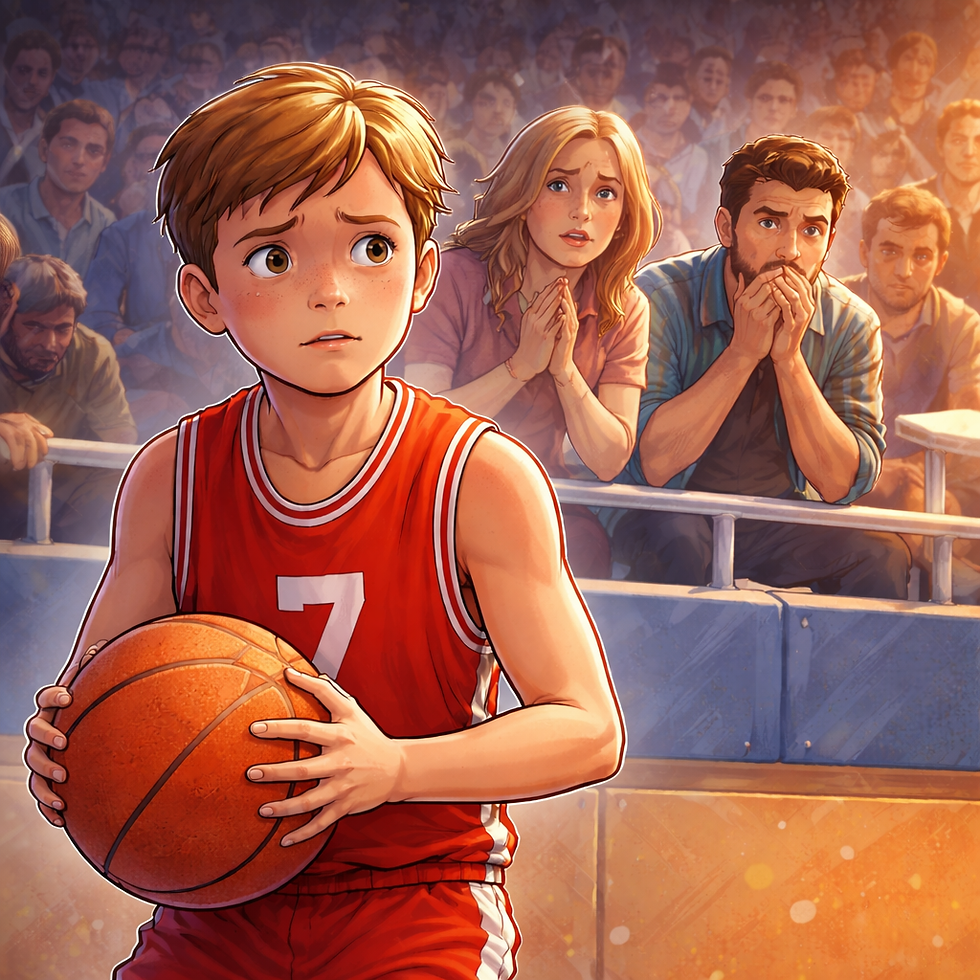
Shoes squeaked across the hardwood with every change of direction, the scoreboard kept shifting almost every possession, and in the stands you could feel that tension only youth sports can create. Parents watching every play as if they could somehow control the game just by paying closer attention. Hands gripping the edge of the seat. Reactions after every mistake. Quick glances toward the scoreboard, the coach, their own child.
In a basketball gym, sometimes it feels like everything happens very fast. Too fast.
A few days later, early in the morning, I was standing on a rugby field. That cold that slips through your jacket before warmups even begin. Mud along the sidelines. Kids with dirty knees laughing after a good tackle. Parents holding hot coffee cups, joking through the steam and wind.
And somehow, in the middle of those completely different atmospheres, I had a thought I had never really had before.
I was living inside two completely different sports worlds.
One fast, intense, where individuality can change a game in seconds. The other built around group effort, contact, patience, and people learning very early that they cannot move forward alone.
And somewhere between a basketball court and a rugby field, without realizing exactly when it happened, I started seeing youth sports differently. Not just the games themselves… but the people around them too.
Sometimes Sports Choose the Kids First
As a parent, you think choosing a sport is something you control.
You analyze options. You search for coaches. You compare programs. You think about which sport might help your child more, which one fits them best, where they might have better opportunities or develop more naturally.
But in reality, many sports stories do not begin that way at all.
They do not begin with a plan.
They do not begin with performance. And most of the time, they do not even begin with the clear idea that “this will be my child’s sport.”
They begin with something much simpler.
With play.
With curiosity.
With meeting the right person at the right moment.
With an energy a child feels long before they can explain it.
For Sasha, everything started with an imaginary basketball hoop.
There were no serious training sessions or performance goals. Just a child spending hours throwing a ball toward a hoop that existed more in his imagination than in reality. With that pure joy children have when they do something simply because it makes them happy.
Looking back now, it almost feels unreal how much can begin from something that simple.
With Mathias, the story was completely different.
Rugby was not even part of our plans. Honestly, if someone had asked us back then whether we could picture our child playing rugby, we probably would have answered quickly: “Probably not.”
And yet, sometimes life changes direction because of one simple sentence said in a park. One ordinary day, coach Guranescu Andrei looked at Mathias and said: “What if he came to rugby?”
That was it.
No pressure.
No promises.
No speeches about performance.
Just a question that, without us realizing it at the time, would open an entirely new world.
I think this is one of the most beautiful things about youth sports. Sometimes sports find children before children even know they are looking for them.
And as parents, we only begin to understand something important much later.
Maybe we are not choosing the path as much as we think we are.
Maybe our role is not to design the perfect roadmap.
Maybe sometimes we simply need to notice the small things that make our children light up from the inside… and have the courage to open the door when life quietly knocks.
“Rugby? Absolutely Not. They Get Hurt.”
I think almost every parent who has never been around rugby has the same first reaction. “Rugby? No way.”
And honestly, that was exactly our reaction too.
Not because we knew a lot about the sport. Quite the opposite. We knew very little. The image we had of rugby was built almost entirely on stereotypes: heavy contact, hard hits, piles of players on the ground, and the feeling that somebody was definitely leaving the field missing a tooth.
Honestly, before rugby, I had this image that we would come home after every practice with a few important parts missing from the child. :)
And I think many parents feel exactly the same.
The interesting part is that very few of them have actually watched a youth rugby practice.
Most reactions come automatically. Almost instinctively.
“It’s too rough.”
“They get hurt.”
“Better another sport.”
But once you start spending time around rugby, you discover something that almost never appears in those stereotypes.
You discover discipline.
Not the rigid kind built on fear. Group discipline. Kids quickly understand that if one player does not do their job, the entire team feels it. They learn that they must take care of their teammates, not just themselves.
You discover respect.
A level of respect that honestly surprised me at times. Respect for coaches. For referees. For opponents. For rules. Even during tense moments, there is this feeling that the game matters more than personal ego.
You also discover calm.
Paradoxically, for a sport many people associate only with impact, rugby often felt like one of the most grounded youth sports I had ever seen. Maybe because the game forces players to trust one another. Maybe because nobody can control everything alone on the field.
And I think this is where my perspective as a parent changed the most.
I realized that sometimes our ideas about a sport are built more from fear than from real experience.
And youth sports have a very interesting way of breaking down those prejudices. Not through theories. Not through complicated explanations. Simply by allowing you to see the people inside the sport itself.
Rugby Changed the Way I Understand Teamwork
One of the things that surprised me most about rugby was how little need there seemed to be for a “main hero.”
Of course there are talented kids. Leaders. Spectacular plays. Players who can influence the rhythm of a game.
But even then, you constantly feel that nobody can carry a match alone for very long.
Rugby keeps reminding you that the game belongs to the group.
And I think that changes the entire atmosphere around the children.
In many sports, without even realizing it, we immediately start looking for:
who scored;
who was MVP;
who “made the difference.”
In rugby, the difference is often made by things almost nobody outside the game truly notices.
The child who steps into the difficult contact first.
The one protecting a teammate.
The one running without the ball to create space for somebody else.
The one doing exactly what the team needs without appearing in any impressive statistic.
There is a lot of invisible work in rugby.
And maybe that is why I often felt parents applauded differently there. Not only the spectacular play. Not only their own child. But the team itself.
It is not always perfect. There are emotions and tensions there too, just like in every youth sport. But the overall atmosphere felt different. Closer to the idea of “we” than the idea of “me.”
And children feel that very quickly.
They learn they cannot move forward alone.
They learn that sometimes they must work hard for moments where somebody else gets the applause.
They learn to trust that their role matters even when it is not the most visible one.
And honestly, I think that is an incredible lesson for life.
Because real life looks far more like a rugby team than an individual highlight clip on social media.
At the same time, basketball taught me to understand the other side of sports as well. There are games that develop individuality, accountability, and the ability to make decisions under pressure much more intensely — and those things are incredibly valuable too.
Maybe this is one of the most beautiful lessons sports can offer when we truly pay attention. Some sports develop individuality. Others develop belonging.
And children probably need a little bit of both to grow well.
Basketball Taught Me How Hard It Is to Always Be “Visible”
If rugby helped me understand teamwork better, basketball made me see very clearly how much pressure can sit on a child when everything becomes visible immediately.
Because in basketball, individuality shows up very quickly.
The court is smaller. The pace is faster. Mistakes are visible instantly. Decisions have to be made within seconds. And sometimes one child can completely change the energy of a game — for better or worse.
That is what makes basketball spectacular.
But I think it is also what makes it emotionally difficult for children.
Around basketball, things appear quickly:
comparisons;
statistics;
labels;
conversations about who scored;
who played more;
who “made the difference.”
And without realizing it, children sometimes begin to feel constantly evaluated.
Especially the children who become highly visible. The ones who score a lot. The ones people start expecting things from all the time.
Basketball taught me how hard it is for a child to always be seen.
Maybe that is why many children end up carrying a pressure adults do not immediately notice, even when they look strong on the court.
Because when you are highly visible, people do not only see the good moments. They also see the mistakes. The weak games. The emotions. Sometimes even the exhaustion or frustration.
And I think one of basketball’s greatest lessons appears exactly there.
Basketball forces you to learn responsibility.
You cannot completely hide. At some point you have to:
make the decision;
take the shot;
continue after a mistake;
move forward even after missing the previous play.
That is why basketball develops accountability and mental resilience so strongly.
It forces you to live with mistakes in public.
And for children, that is not easy at all.
We adults sometimes forget how difficult it is to fail in a gym where:
there is a scoreboard;
there are reactions;
there are statistics;
there are comments;
and there is the feeling that everyone notices.
Maybe that is why I started seeing differently the children who still have the courage to play freely after a major mistake. Or after a bad game. Or after a moment when the entire gym seemed to expect something else from them.
Because beyond points and results, there is an invisible pressure many children carry quietly.
And honestly, basketball taught me not only how important talent is… but also how important it is to emotionally protect children who become highly visible too early.
The Atmosphere Created by Adults Changes the Entire Experience for Children
I think one of the most important things I have learned over the years is that youth sports are not built only from practices, tactics, or results.
They are also built from the atmosphere created by the adults around the children.
From the stands.
From conversations between parents.
From reactions after mistakes.
From the tone used in the car ride home.
From the way we talk about our own children… and other people’s children.
And maybe living inside two very different sports at the same time made me notice these things more carefully.
In some gyms, you feel tension before the game even starts.
In others, you feel more of a community.
In some places, children’s mistakes instantly become discussion topics for adults.
In others, there seems to be more patience for development and for the invisible roles inside a team.
I am not saying one sport is “better” than another. That would be unfair and superficial. In the end, people create the atmosphere, not the sport itself.
But this experience made me realize something very important:
Adults shape the culture of a sport far more than we think.
Children notice immediately:
whether the stands feel tense;
whether parents constantly compare;
whether mistakes are accepted or punished;
whether everything revolves only around results;
whether adults respect one another;
whether the team is viewed as a group or simply as children competing for attention.
And without realizing it, we adults sometimes make the sports experience heavier than it should be for children who are still learning.
I think this was one of the moments when I started looking differently at myself as a parent too.
Not only at what my child does on the field… but also at the energy I bring around him.
Because youth sports are not played only on the field.They are also played in the way adults choose to live that journey alongside the children.
And sometimes the biggest difference for a child is not the perfect practice or the perfect game.
It is the atmosphere in which they are allowed to grow.
Very often, a child’s experience after a game is influenced more by the reaction of adults than by the final score itself.
What Rugby and Basketball Actually Have in Common
After all the differences I started noticing between rugby and basketball, I eventually realized that the most important things are not what separates them.
It is what connects them.
Yes, the atmosphere is different.
The rhythm is different.
The pressure feels different.
Even the way children relate to the game can feel different.
But beyond all of that, both sports build the exact things that truly matter long term.
Character.
Discipline.
Relationships.
Resilience.
Confidence.
Adaptability.
Belonging.
And honestly, almost none of those things fully appear in statistics.
You do not see the child who is exhausted but keeps running for the team.
You do not see the teammate lifting up a friend after a mistake.
You do not see the moment a coach says exactly the sentence a child needed on a difficult day.
Maybe that is why youth sports are so difficult to explain to people who only look at results.
Because real development often happens inside small, repetitive moments almost nobody notices.
On the drive to practice.
Inside routines built over time.
In the moments children learn how to lose without losing themselves.
In the way they slowly learn to care about teammates.
In the discipline that quietly appears before anyone even realizes it is there.
And I think this is where sports become more than sports.
They become spaces where children slowly learn how to function in the world.
How to collaborate.
How to adapt.
How to stay competitive without losing respect for others.
How to continue even when nobody applauds.
Maybe rugby and basketball teach different lessons at different moments.
But both force children, in one way or another, to grow.
And we, as parents, are sometimes lucky enough to witness that transformation very closely — even if it does not always appear in trophies, statistics, or social media posts.
Because some of the most important victories in youth sports are almost invisible.
Sports Did Not Only Change the Children. They Changed Us Too.
At first, like many parents, I thought I was bringing my children into sports for them.
For movement.For discipline.For friendships.For development.
And in many ways, that was true.
But over time, I started noticing something I had barely considered when all of this began.
Sports were not only changing them.
They were changing us too.Little by little.
Sports change you when you begin understanding that real progress is not linear, even when you desperately want it to be as a parent.
They change you when you learn patience after a bad game. Or when you realize your child sometimes needs silence more than analysis.
They change you when you begin noticing how much pressure can exist behind a child who looks “strong.” Or how meaningful a simple: “I loved watching you play today”can become.
They change you when you start paying attention to small things you once considered unimportant:
the teammate encouraging a friend after a mistake;
the coach staying patient on a difficult day;
the child who keeps working without being the center of attention;
the parent who chooses support over control.
And maybe this is one of the most unexpected gifts youth sports can offer.
They do not only teach us how athletes grow.
They teach us how adults grow too.
How to become more attentive.More patient.More aware of the impact we have.Sometimes even more human.
Today, after years spent between basketball gyms, rugby fields, emotions, victories, defeats, long drives, and late-night conversations after games, I think I understand this journey differently.
At first, I thought sports would shape the children.
Today, I believe sports slowly shape the adults standing beside them too.
And maybe that is one of the most beautiful things about youth sports.
The children are not the only ones growing.
We grow alongside them.
Frequently Asked Questions About Rugby, Basketball, and the Parent Experience in Youth Sports (FAQ)
Is rugby too rough for children?
This is probably one of the most common reactions from parents who have never been around rugby before. And honestly, it was exactly our reaction at the beginning too.
In reality, youth rugby is about much more than physical contact. It teaches discipline, clear rules, respect for teammates, and responsibility toward the group. Of course, it is a contact sport, and parents’ concerns are completely normal. But once you start watching practices and spending time around the culture of the sport, you realize rugby develops collaboration, belonging, and respect for others in a very powerful way.
Most of the time, the fear comes more from the unknown than from the actual experience of being around the field.
How do children choose the right sport?
Usually far less logically than adults think.
Some children discover sports through play. Others through a friend, a coach, a random moment, or simply through a feeling they cannot yet explain in words. Sometimes an apparently small moment can completely change the direction of a child’s life.
As parents, we tend to search for the “perfect” sport. In reality, the most important thing is noticing where a child feels alive, curious, and excited to come back.
Sometimes the right sport is not the one we choose for them. It is the one where they slowly begin to recognize themselves.
Is it normal for the atmosphere created by parents to influence children’s sports experience?
Yes. Probably more than we realize.
Children quickly feel tension, comparisons, disappointment, or pressure coming from the adults around them. But they also feel healthy support, patience, and emotional safety just as quickly.
Youth sports are not built only through practices and games. They are also built through the atmosphere created in the stands, during the drive home, and in the way adults talk about mistakes, development, and progress.
Very often, a child’s emotional experience after a game is shaped more by the reaction of adults than by the final score itself.
What do team sports develop more: individuality or team spirit?
Probably the best sports develop both.
Some sports place more emphasis on individual responsibility, quick decisions, and personal accountability. Others develop collaboration, sacrifice, and the idea that the team matters more than a single player.
Children need both confidence in themselves and a sense of belonging as they grow.
Maybe one of the most beautiful lessons sports can teach is exactly this: helping children grow as individuals without ever forgetting they are part of a team.
Some stories stay outside the article.
Once a month, in the newsletter Quietly.
Subscribe via the Newsletter page.


Comments