“What About Saturday?” When You’re Getting Better but Still Don’t Know If You’ll Play

Same Practice. Everyone Sees Something Different. — Episode 02: The Teenager
Today, It Finally Clicked
“Stay in front of him!”
Too late.
The teammate facing him fakes right, changes direction, and drives to the basket before the teenager can even turn around.
Again.
For weeks, he's been trying to stop that exact move. He's practiced his defensive slides, listened to his coach's instructions, and repeated the footwork until it finally started to feel natural.
During drills, anyway.
Because in a five-on-five game, your opponent isn't exactly going to wait while you remember what you practiced.
“Come on, next play!” a teammate calls.
He runs back on defense.
A few minutes later, there it is again.
Same opponent. Ball in his hands. Fake to the right.
Except this time, the teenager doesn't bite.
He stays balanced, slides sideways, and cuts off the drive.
His opponent tries to change direction.
The teenager is still there.
Eventually, the other boy has to pass.
No spectacular steal. No crowd-pleasing block.
Just an opponent who couldn't get past him.
The teenager clenches his fist for a second.
He did it!
A “Good Job” Can Mean a Lot of Things
“Good job! That's how you stay in front of him!” the coach calls out.
The teenager smiles.
It's not the first time he's heard “good job.” But he's been waiting a long time for this one.
He knows how many times he's messed up that move. How often he's reacted too early to the fake. How many times he's ended up watching his opponent race toward the basket.
On the next possession, his teammate tries again.
Another fake. Another change of direction.
And once again, the teenager stays in front.
This time, his teammate laughs.
“Dude, what's gotten into you today?”
“Guess I finally learned something!”
They both laugh and keep playing.
That's what he loves about basketball.
Trying something ten times without getting it right, then suddenly realizing you can do it. Running until you forget how tired you are. Hearing the ball bounce off the hardwood, teammates calling for passes, the coach shouting for one more play.
He even loves those conversations after practice when everyone knows exactly how a possession should have gone. Especially the guys who weren't involved in it.
But more than anything, he loves playing.
Once a five-on-five game starts, he forgets about school, homework, and who's replied to his messages. He wants the ball. He wants to defend. He wants to be right in the middle of the action.
For a few minutes, he simply enjoys what he's achieved.
Then the coach calls out:
“Alright, last five minutes!”
And he remembers.
They have a game on Saturday.
Will he make the roster this time?
What Does Being Ready Really Mean?
On the next possession, the teammate he's just managed to stop intercepts a pass.
He takes off on the fast break, draws a defender, and dishes the ball to an open teammate.
Basket.
“Great job! Excellent vision!” the coach shouts.
The teenager watches the play.
It was good. Really good, actually.
A little later, it's his turn to make a mistake.
He's late on a defensive switch and leaves an opponent wide open under the basket. On the next possession, he rushes a pass and turns the ball over.
“Don't rush!” the coach tells him.
He bites his lip and sprints back.
So frustrating.
He's finally fixed something he's been working on for weeks, only to discover there's still plenty more to fix.
But that's not what's bothering him most.
He hasn't been selected for the last few games.
And it's starting to get tough.
Not because he's stopped enjoying practice. Quite the opposite. He'd play basketball almost every day if he could.
But now he wants something else, too.
To be on the court when a real game starts. To feel the pressure of an opponent he hasn't already faced a hundred times at practice. To hear the whistle, catch a pass, and have to make a decision in a split second.
To help his team.
He doesn't need to score twenty points. He'd be happy with a good defensive stop. An important rebound. A pass that gives a teammate an open shot.
He just wants the chance to do those things.
He loves his team. He's happy when his teammates win. But sometimes, when he hears them talking about their games, he gets this strange feeling.
They were all there.
He only knows what they've told him.
And he starts comparing himself.
One teammate is faster. Another shoots better. Someone else spots passes he doesn't see until it's too late. But there are things he knows he's getting better at, too.
At practice, he can see those differences. He feels them in every one-on-one battle, every drill.
What he doesn't know is which things matter most when the coach picks the roster.
Today, for example, he stopped an opponent twice who used to get past him almost every time.
That much he knows.
But is he any closer to playing on Saturday?
That's the part he doesn't know.
The Question That Doesn't Quite Get Answered
Practice ends.
Basketballs start disappearing into the rack by the wall. One teammate is looking for his water bottle. Another insists someone's taken his hoodie.
The hoodie is under his own bag.
Nobody seems particularly surprised.
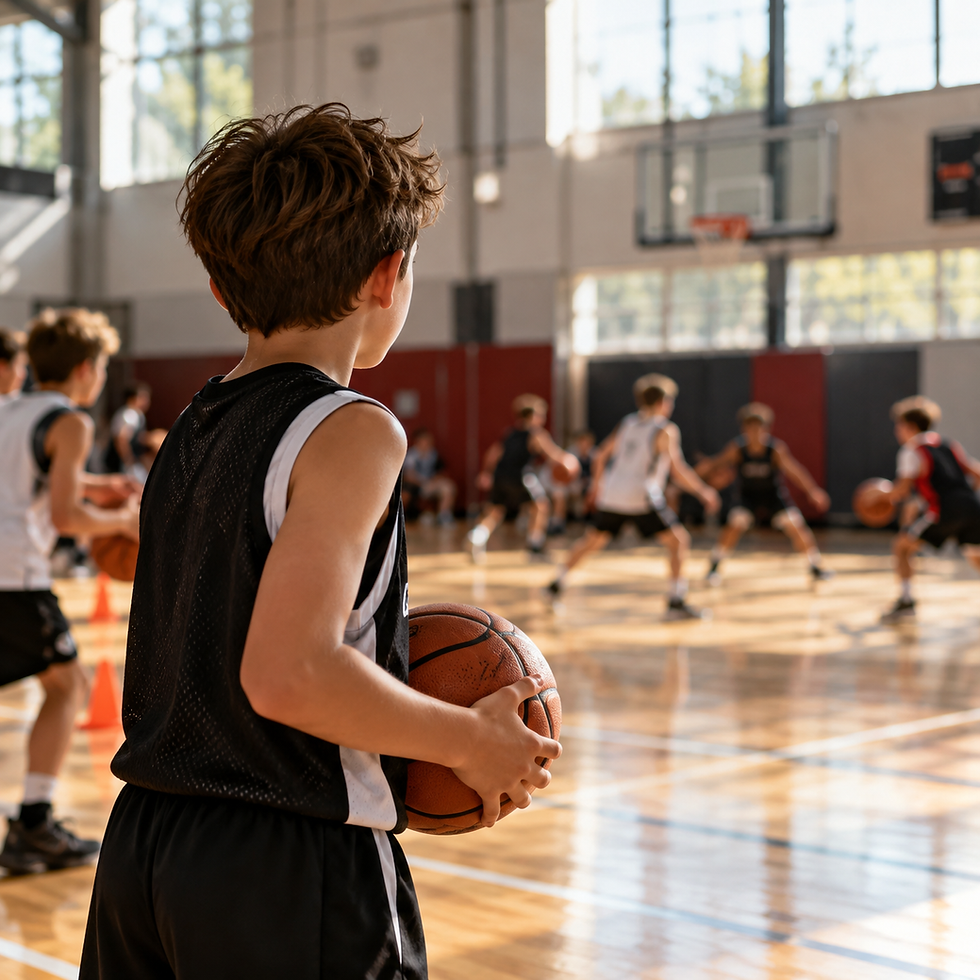
The teenager hangs back near the court.
The coach is talking to two players. He waits until they're finished, then walks over.
“Coach?”
“Yeah?”
“Was I better today?”
“Yeah. Especially on defense. You stayed in front of your man instead of biting on that first fake. That's what I want to see.”
The teenager smiles.
“What about... Saturday?”
The coach pauses.
“We haven't picked the roster yet. We've got one more practice, and I need to see what we need for the game.”
“Yeah, but... what am I still missing?”
“A few things. Your defense was better today, but you rushed some passes. And you were late on that switch.”
“I know.”
He hesitates for a moment.
“But you said I was better last week, too. And I still didn't make the roster.”
The coach looks at him.
“I know. But I don't choose the roster based on one practice. It depends on who we're playing, which positions we need to cover, how the players fit together...”
The teenager listens.
He's not asking to be picked just because he shows up to every practice. And he doesn't believe two good defensive plays automatically earn him a spot.
He just wants to understand where he stands.
“So what if I have a really good practice on Thursday?”
“That would be great. But I can't promise you'll be on the roster.”
“That's not...”
He stops.
He doesn't want to sound like he's arguing with his coach. Or questioning every decision he makes.
“I just want to know if I'm getting closer.”
The coach takes a moment before answering.
“You're better than you were a month ago. I can see that. Keep working. But selection isn't just about that.”
“Okay. Thanks, Coach.”
He picks up his bag and heads toward the locker room.
He'd hoped for a clearer answer.
Not necessarily, “Yes, you're playing.” He knows nobody can promise him that.
Just something that would help him understand what to do next.
He stops near the door.
“Coach, on that play where I was late switching... should I have called it earlier?”
“Exactly. Your teammate needs to know you're switching before you leave your man. Not when it's already too late.”
“Got it.”
This time, he has an answer he can actually use.
He still doesn't know whether it will be enough to get selected on Thursday. But he knows what he wants to do differently.
In the locker room, the teammate who used to beat him so easily asks:
“Seriously, what did you do today? I couldn't get past you!”
“Learned not to fall for the first fake.”
“Oh, so now I've got to try something different on Thursday.”
“Go ahead!”
They both laugh.
The teenager takes off his basketball shoes and puts them in his bag.
He thinks about the defensive play he got right. The switch he missed. What he could try on Thursday.
Then his mind goes back to Saturday.
He still wants to play. Maybe more than ever.
But those two good defensive stops haven't disappeared just because he doesn't know whether he'll be selected.
They happened. On the court. He made them happen.
And on Thursday, he wants to try again.
Same Gym. Different Question.
As the younger boy leaves the gym, he spots his older brother.
“I made an awesome pass!” he says excitedly.
His brother gives him a quick smile.
“Nice.”
“How did your practice go?”
“Good.”
But he doesn't look like it went well.
“Are you playing Saturday?”
“Probably not.”
“Why?”
The teenager shrugs.
“I wish I knew.”
The younger boy doesn't seem to understand why his brother isn't happier.
He's just had an amazing practice.
He made a pass to Vlad. Vlad missed the shot, but that doesn't bother him much. He spotted Vlad open. He looked up at exactly the right moment.
And he can't wait to tell everyone.
Their dad is waiting near the exit, dressed in running gear, with a sports watch on his wrist.
“Dad! You have to hear about this pass!”
He launches straight into the story. Arms flying, whole body moving, practically recreating the play among the people leaving the gym.
Dad has to step sideways to avoid taking an imaginary pass straight to the chest.
“Got it!” he laughs. “Great pass!”
The teenager smiles, too.
He loves seeing his little brother this happy.
“What about you?” Dad asks.
“It was good. I finally stopped that teammate who always gets past me. Twice.”
“Really?”
“Yeah. I didn't fall for the first fake.”
For a moment, the same excitement he felt on the court comes back into his voice.
Then he adds:
“Still don't know if I'm playing Saturday, though.”
Dad looks at him but doesn't rush to say he'll definitely get his chance. He has no way of knowing.
“What have you got on Thursday?”
“One more practice. I want to be better at calling defensive switches. I messed one up today.”
“Got it.”
That's all.
It's not a conversation that fixes everything.
The teenager still wants to know if he'll play. It still bothers him that he doesn't have an answer. But he also knows what he achieved today. And on Thursday, there'll be a basketball in his hands and an opponent in front of him again.
His little brother has finally finished telling everyone about his pass.
For now, at least.
They start walking toward the car.
After a few steps, the younger boy notices Dad's running clothes.
“Did you have practice, too?”
“Yeah. I went for a run.”
“By yourself?”
“By myself.”
“How was it?”
“Good.”
The teenager smiles. That answer sounds familiar.
But his little brother isn't finished asking questions.
“So what did you get better at today?”
Dad looks down at his watch.
The screen shows his distance, time, and pace. Clear numbers. Some better than last time, others not.
The boy waits for an answer.
Dad looks at the screen again.
Then he looks up.
And for the first time that evening, the question about practice is his to answer.
FAQ
1. Why am I not selected for games even though I attend practice and keep improving?
Because individual progress and team selection aren't the same thing. Your coach may consider your current level, the opponent, the roles the team needs, and how players fit together. You can genuinely improve without making the roster right away. That doesn't erase your progress, but it doesn't automatically guarantee you a spot either.
2. How can I tell if I'm improving when I don't make the game roster?
Compare what you can do today with what you could do a few weeks ago. Maybe you can stay in front of an opponent who used to beat you, make quicker decisions, or handle difficult situations with fewer mistakes. Look for specific changes and ask your coach for feedback. Making the roster is one decision. Your progress deserves to be measured separately.
3. What should I ask my coach if I don't understand why I'm not on the roster?
Instead of only asking, "Why don't I get to play?", try something more specific: "What do I need to improve to be better prepared for games?" You can also ask for an example from practice or what your coach expects from your role on the team. You might not get a promise about selection, but you can get useful direction for your next practice.
The series continues with Episode 03 - The Adult Athlete. Same evening, another training session, and the father's perspective.

Comments