Do Parents Love Victories More Than the Kids Who Win Them?

Updated: May 8
You’ve seen it before, haven’t you?
The child gets the diploma, lifts the small trophy with shy hands and the parent… already films, posts, tags, and captions it with “So proud of my little champion!”
The child smiles. Not because they grasp the meaning of “success”, but because they know - if they don’t smile, the picture won’t look good.
And somehow, everyone in the room can feel that the joy isn’t really theirs.
Here’s the sad paradox: when parents love victories too much, kids start enduring them in silence.
Adults often mistake their children’s success for their own validation. We want proof that we’re good parents - involved, dedicated, always there.
But kids don’t chase medals. They chase moments when someone truly sees their effort, not just the result.
And sometimes, in that tight hug after a win, a quiet question flickers in their minds:
“Would you still be proud if I had lost?”
There’s nothing wrong with pride. But when love for the victory becomes louder than love for the child, the trophy stops shining - it just highlights the distance between us.
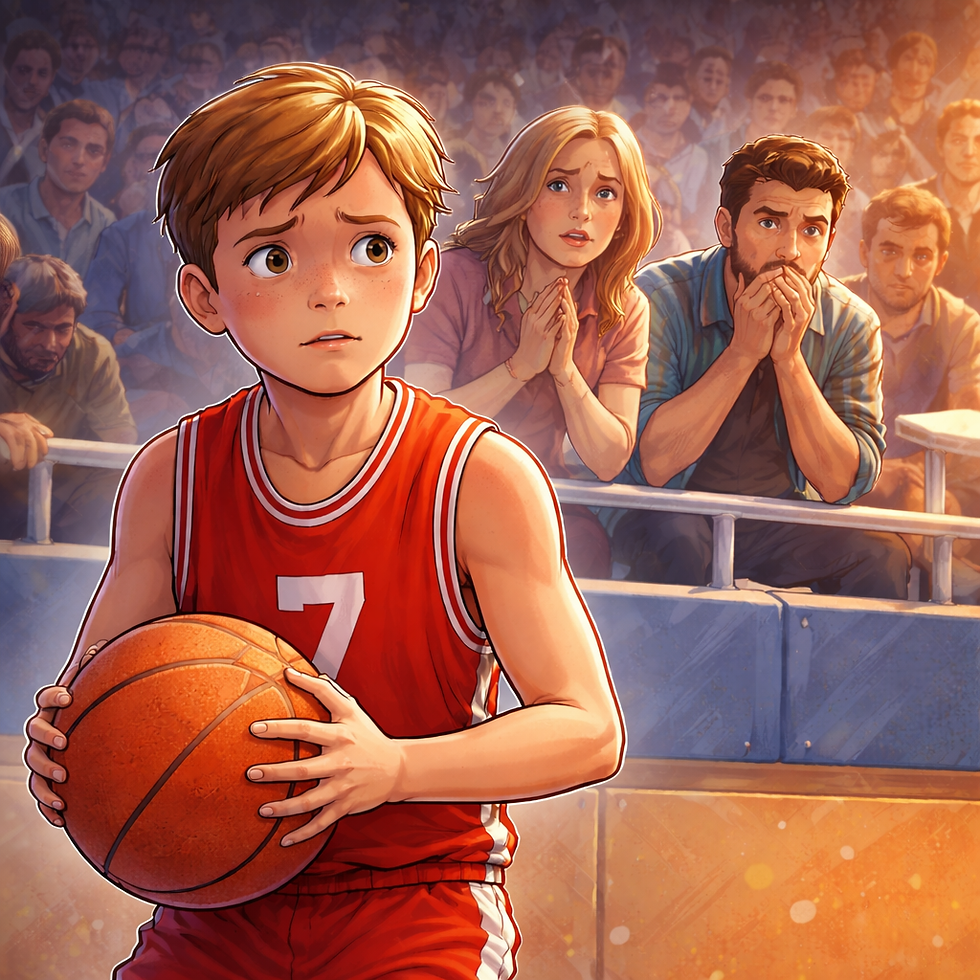
How many times did you celebrate for your child… and how many times instead of them?
Update May 2026
Sometimes, a Win Doesn’t Just Change the Score. It Changes the Entire House.
A lot of the time, the game doesn’t really end when the buzzer sounds. It ends in the car ride home. That’s where the part nobody truly talks about in youth sports begins.
Not in the stands.
Not on the court.
Not in the trophy photo.
But on the drive home, when the adrenaline slowly fades and emotions start showing up uninvited.
After a win, the atmosphere changes instantly. Even the GPS somehow sounds friendlier. The music gets louder, conversations flow naturally, and eventually someone says the inevitable: “Alright, let’s go get something good to eat.”
Phones start buzzing from every direction. Grandparents receive photos before you even leave the parking lot. Parent group chats suddenly become more active than stock market traders on a Monday morning. And the child, still sweaty and exhausted, feels something they probably can’t explain yet: the adults are relaxed.
Everything feels lighter.
Even the questions sound different.
“Did you have fun?”
“That move you made was incredible!”
“You were amazing today!”
And the truth is, nobody is pretending. The joy is real. The emotion is real. Parents are genuinely happy.
But children feel that too. Especially the contrast.
Because after a loss, the exact same car can suddenly feel two sizes smaller. The music disappears. Phones go quiet. Conversations turn into tactical breakdowns delivered by people who, two hours earlier, still needed Google Maps to find the correct gym entrance.
“Where did the game fall apart?”
“Why didn’t you take the shot?”
“You just didn’t look like yourself today…”
And sometimes, nobody says anything at all. Which is strange, because silence often says the most.
Children notice all of this long before they truly understand standings, rankings, or how important a competition is supposed to be. They notice the tone of voice. The rhythm of the conversation. The way parents breathe after the game. Whether they laugh. Whether they look tense. Whether they stare out the window… or immediately start searching for the perfect Instagram photo.
As adults, we tend to think children remember the scoreboard.
Very often, they remember the atmosphere instead.
It’s Not Just About Pride. It’s About Relief.
There’s an idea repeated so often in sports that it has almost become a final verdict: “Parents are living through their children.” And yes, sometimes that does happen. But the truth is that, in many families, things are far more complicated, and far more human, than that.
Most of the time, parents don’t love winning because it makes them feel important.
They love it because victory brings something incredibly rare into the life of a sports parent: relief. For a few hours, everything feels like it makes sense.
The endless driving across town at impossible hours.
Weekends that quietly turned into tournaments.
Meals eaten quickly at gas stations.
Money mysteriously disappearing on “one more pair of shoes that are absolutely necessary this time.”
Waking up early while your body is still negotiating with coffee about whether functioning today is really worth it.
And maybe the hardest part of all: the constant doubt.
Am I doing the right thing by pushing?
Am I helping them… or exhausting them?
Am I building discipline or stealing part of their childhood?
Should I encourage them more?
Or am I risking quitting too early on something that could have become important for them?
A lot of this tension is invisible from the outside. Which is exactly why many parents don’t even realize when their emotions slowly become a form of invisible pressure for the child, even when their intentions come from love. We talked more about this in the article about pressure in youth sports and how parents can recognize it.
Almost no parent speaks honestly about how exhausting these questions can become. Because from the outside, youth sports look beautiful: photos, medals, fresh uniforms on the first day of the season, motivational videos with dramatic background music and slow-motion highlights.
But reality also has less cinematic moments.
Like washing sports gear at 11:40 PM while quietly praying it dries by morning.
Or realizing you’ve spent more time searching for one missing sock than you’ve spent on your own hobbies in the last two years.
And maybe that’s why victory sometimes creates an emotion that feels less like pride… and more like relief.
“Maybe we’re not doing everything wrong after all.”
It’s a sentence many parents never say out loud, but deeply feel.
Because sometimes, parents are not celebrating the trophy itself. They’re celebrating the fact that, for one evening, they stop questioning whether they’re doing this parenting thing correctly.
And this is where the sensitive part of the story begins.
Children feel that relief too, even if they cannot explain it yet. They feel that winning doesn’t only bring joy, it brings calmness into the adults around them. For a few hours, everyone breathes easier.
And without realizing it, the result slowly starts carrying far more emotional weight than just a game.
Children Learn Adult Emotions Before They Understand Competition
An 8-, 10-, or 12-year-old child may not fully understand defensive systems, standings, or why “this game matters for qualification.” But there is something they read almost instantly: adult emotions. And they read them incredibly well.
Long before children understand competition, they learn the atmosphere around it.
They learn the tone behind the question, “How did it go?”
They learn the difference between peaceful silence and heavy silence.
They notice the facial expressions parents try to hide.
The energy behind a car door closing after the game.
The sigh after a mistake.
Or that quick “It’s okay…” delivered so fast that everyone understands it’s probably not okay at all.
Children notice all these things before they know what a good shooting percentage is or why a coach calls a timeout.
In reality, children begin learning what winning means through their parents’ reactions, not through the scoreboard.
After a win, everyone feels closer somehow. People talk more. Laughing comes easier. Jokes appear again. The family relives moments from the game as if they had just survived a big-budget action movie together with a happy ending.
“Did you see that three-pointer?”
“When you stole that ball I thought the gym was going to explode!”
“Hold on, we have to send this picture to Grandpa!”
The atmosphere becomes warm. Connected. Light. And the child feels that.
Sometimes, after a game, the most important thing isn’t the words themselves. It’s the tone, the energy, and the way the first few minutes of conversation begin. Those small moments can make a child feel emotionally safe… or constantly evaluated. We wrote more about this in the article about what to say to your child after a game.
The problem is that children also feel the opposite.
After losses, many kids enter a strange emotional state where they stop focusing only on the game itself. Instead, they begin emotionally monitoring the adults around them.
They check whether Dad is still talking normally. Whether Mom still seems relaxed. Whether people are actually talking in the car… or everyone is silently staring at their phones like they’re filming an emotional survival documentary.
And sometimes, something very difficult to notice from the outside begins to happen: the child starts feeling responsible for fixing the atmosphere.
They become more careful.
More emotionally alert.
More responsible for everyone else’s feelings than a child should ever need to be after a game.
Some children immediately start joking after losses just to lighten the mood.
Others become overly self-critical before parents even say anything, almost as if they’re trying to control the disappointment before it grows.
“I know, I played badly…”
“It was my fault…”
“I’ll do better next time…”
And the hardest part is that, most of the time, parents never intended to communicate any of this.
But children absorb adult emotions like a sponge with no off switch.
And slowly, some of them begin believing that their role is not just to play… but to keep the entire family emotionally okay.
That’s the moment when sports start becoming heavier than they were ever supposed to be for a child.
When Winning Becomes Emotional Safety
At the beginning, sports are simple for children.
They run. They play. They argue over the ball. They forget the score on the way home and ask if they can still spend five more minutes at the park. For them, competition does not yet carry the emotional weight it carries for adults.
But slowly, almost invisibly, something begins to change.
Not through dramatic motivational speeches.
Not during a serious family conversation.
But through small moments repeated hundreds of times.
In the way the house feels calmer after a win. In how parents seem more relaxed, more present, more emotionally available. In evenings where everyone laughs more and nobody seems in a hurry to end the conversation.
And without realizing it, the child starts connecting the dots.
Winning means connection.
Winning means closeness.
Winning means validation.
Winning means everybody is okay.
Not because anyone directly told them that, because the atmosphere quietly teaches it.
And this is how one of the quietest forms of pressure in youth sports begins: the fear of emotionally changing the world around them.
And honestly, that fear is much heavier than missing a shot or losing a game.
Because many children are not only afraid of losing. They are afraid of the colder, more exhausted, more tense version of the adults who appear after losses.
That is why, sometimes, after a bad game, the first thing a child says is:
“I’m sorry.” Not “We lost.” Not “I played badly.” But “I’m sorry.”
As if they feel they damaged something bigger than the scoreboard itself.
And this part deserves to be understood with a lot of gentleness: most parents do not create this intentionally. They are not emotionally manipulating their children. They are not making love conditional.
They are simply tired, emotionally invested, deeply involved, and sometimes so consumed by the entire process that their reactions become impossible to fully hide.
And children are experts at noticing what adults believe they are hiding well.
Maybe that is why one of the truest and saddest realities in youth sports is this:
Some children are not playing for the trophy. They are playing for the atmosphere afterward.
For the peaceful drive home.
For the jokes after the game.
For the dinner where everyone talks comfortably again.
For the warm version of the people they love.
And maybe this is exactly where we should pause for a moment and ask ourselves something uncomfortable, but important:
How much of the pressure children feel actually comes from their desire to protect the emotions of the adults around them?
Because over time, this need to keep everything emotionally “okay” can slowly turn sports into a place where children become more afraid of making mistakes than excited about playing the game itself.
And that is often one of the deepest hidden roots of fear of mistakes in sports.
The Problem Is Not That Parents Love Winning
It would be very easy for this article to say: “Parents put too much pressure on kids. Stop turning youth sports into a drama.”
But real life is rarely that simple.
Sports create emotion. A lot of emotion.
It is normal to jump out of your seat after a game-winning shot.
It is normal to feel that knot in your stomach before tip-off.
It is normal to feel proud when you see your child being brave, disciplined, or genuinely happy on the court.
And yes, it is completely normal to feel real joy when they win.
The problem is not the emotion itself.
The problem only begins when the result starts changing the way the child feels seen, heard, or accepted. Because children notice very quickly the difference between: “We’re happy you won.” and “Things feel better now that you won.”
To adults, the difference may seem small. To a child, it can completely change the way sports feel.
Children are far more resilient to losing than we often think. Seriously. Many of them recover from losses surprisingly fast. They may cry for ten minutes… and then immediately ask if they can still have dessert or go hang out with a friend.
Children have an incredible ability to bounce back emotionally when they feel safe.
What truly affects them is not always the score. It is the change in atmosphere.
The moment parents become colder. More distant. More tense. Harder to emotionally reach. Or, even more subtly, when the entire house somehow feels different after a loss.
Sometimes, children can handle losing a game without much difficulty.
What they struggle with more is the feeling that they lost the warm version of the people waiting for them at home.
And this is where one of the most mature questions a sports parent can ask themselves appears: “Is my child afraid of losing… or afraid of what happens around them after losing?”
Because there is a massive difference between a child who wants to win and a child who feels they need to win so everyone around them can emotionally be okay.
The first child plays freely.
The second child plays while carefully monitoring everybody else’s emotions.
And that becomes exhausting for a child, even when they do not yet have the words to explain why.
Maybe the Real Victory…
Maybe the real victory is not the moment your child lifts a trophy while parents clap from the stands holding phones with 3% battery left and somehow still managing to record everything.
Maybe it is not the perfect post-game photo.
Not the medal carefully placed on the car dashboard “so it looks nice.”
Not even the family group chat that suddenly becomes incredibly active after wins and mysteriously silent after losses.
Maybe the real victory is something far harder to build and far less visible from the outside.
The moment a child knows they can lose without feeling like they also lost the emotional peace of home.
The moment they get into the car after a bad game and do not feel responsible for fixing everybody’s mood.
The moment they can say: “I just didn’t have it today.”
…without feeling like they disappointed the entire emotional atmosphere of the family.
Because the truth is, children do not need emotionless parents. That would be impossible. And honestly, a little strange. If your child hits a game-winning shot and you react like you just checked laundry detergent prices at the supermarket, we probably have a completely different issue to discuss. 😊
Children need to see emotion. Joy. Excitement. Pride. They need to feel that what they do matters.
But they also need something even more important:
The safety of knowing the relationship does not change with the scoreboard.
That after a loss, there is still closeness. Calmness. Jokes. Connection. Normal life.
That they do not have to win in order to keep the warm version of the people they love.
And maybe this is where one of the healthiest forms of support in youth sports truly begins: not when we remove emotion from the stands, but when children understand that our emotions do not completely depend on the scoreboard.
Because trophies fade. They get placed in boxes. They collect dust. Sometimes we cannot even remember which season they came from.
But the way a child felt at home after losing…
…stays with them far longer than the score ever will.
Frequently Asked Questions About Parental Pressure and Children’s Emotions in Sports (FAQ)
Is it normal for parents to be very emotional during their children’s games?
Yes. Absolutely. Youth sports involve time, energy, emotions, and a huge amount of parental involvement. Feeling joy after a win or disappointment after a loss does not automatically mean a parent is creating pressure. The problem only begins when the child starts feeling that the atmosphere, relationships, or emotional state of the family depend too heavily on the result. Children need to see genuine emotion, but they also need to feel loved and accepted regardless of the score.
How do children notice when parents are emotionally affected by the result?
Children notice far more than adults often realize. Long before they understand tactics or the importance of a competition, they read tone of voice, facial expressions, silence, tension, and emotional energy, especially during the drive home after games. After wins, the atmosphere often feels lighter and more connected. After losses, it can become colder or more tense. Even when parents say nothing negative directly, children quickly sense emotional changes around them.
Why do some children become so afraid of losing?
In many cases, the fear is not only about competition itself. Some children begin associating winning with closeness, relaxation, emotional connection, and peace at home. Over time, losing starts feeling like something much bigger than a sports result. A child may feel responsible for keeping everyone emotionally okay after games. This kind of pressure can slowly transform sports from something joyful into a constant source of anxiety and fear of mistakes.
How can parents reduce emotional pressure around sports?
Not by becoming emotionless, but by creating emotional stability. It is completely normal for parents to feel excitement, pride, disappointment, or frustration. However, children need to feel that connection, warmth, and acceptance do not disappear after a bad result. Sometimes the most important things after a game are a calm tone, a normal conversation, a joke, or simply maintaining a safe and emotionally steady atmosphere regardless of the scoreboard. Children usually handle losing better than they handle emotional distance from the adults around them.
Some stories stay outside the article.
Once a month, in the newsletter Quietly.
Subscribe via the Newsletter page.


I wish i knew few years ago all these things!
Thank you ACS MAAS for sharing 🤗